Spain Housing Protests Resume After Parliament Rejects Tenant Protections
Fresh protests over housing are due to take place in Madrid and other Spanish cities on Saturday, October 3, 2026, a day after parliament rejected two government measures designed to strengthen protection for tenants. The defeat has intensified a wave of demonstrations that began after the highly publicised eviction of an elderly woman from her long-term Madrid home and has placed renewed pressure on the minority government of Prime Minister Pedro Sánchez.
The Parliamentary Defeat
On October 2, Spain’s Congress voted down two decree-laws presented by the Socialist-led coalition. The package included the automatic renewal of rental contracts when they expire, along with measures aimed at restricting the eviction of vulnerable tenants. Other elements reported in the proposals covered limits on speculative purchases by investment funds, regulation of temporary and room rentals, and related steps intended to ease pressure in the rental market.
The votes were close but decisive. One decree was rejected by 178 votes to 172, and the second by 184 to 166. Opposition came from the conservative Popular Party, the far-right Vox, and the Catalan separatist party Junts, whose support had been considered essential for passage. Junts argued that the measures lacked rigour and risked reducing the supply of rental housing while potentially pushing prices higher. The outcome marked another political setback for Sánchez and has raised fresh questions about the stability of his minority government ahead of the next scheduled general election in 2027.
The Spark That Ignited Nationwide Anger
The immediate catalyst for the current wave of protests was the eviction of 87-year-old Maricarmen Abascal from a Madrid apartment she had occupied for around seven decades. Unable to afford a sharp rent increase demanded after the property changed hands to an investment fund, she was removed from the building on a stretcher. The images and reports of the eviction generated widespread outrage and rapidly escalated into organised demonstrations across Spain.
Campaigners and tenants’ groups framed the case as emblematic of deeper problems: soaring rents, the growing role of large investment funds in residential property, the conversion of housing into short-term tourist rentals, and the particular vulnerability of long-term and older tenants. Within days, protest camps appeared in major cities. In Madrid, activists established a sustained encampment in Puerta del Sol, one of the capital’s most visible public squares. The camp grew substantially over the course of a week, becoming a focal point for daily organising and a symbol of the broader movement.
The Scale of the Housing Crisis
Spain has faced mounting housing pressures for several years. In major cities and tourist destinations, rents have risen sharply, pricing many young people, families and fixed-income households out of the market. The shortage of affordable long-term rentals, combined with the expansion of short-term holiday lets and purchases by institutional investors, has fuelled a sense that housing is increasingly treated as a financial asset rather than a basic need.
The government’s decrees were presented as an emergency response to this discontent. Supporters argued that automatic contract renewals and stronger eviction protections would provide immediate relief to tenants facing insecurity. Critics, including parties that voted against the measures, contended that the proposals could discourage private investment in rental housing and ultimately worsen supply shortages. The parliamentary rejection has left the original protections without legal force and has returned the political argument to the streets.
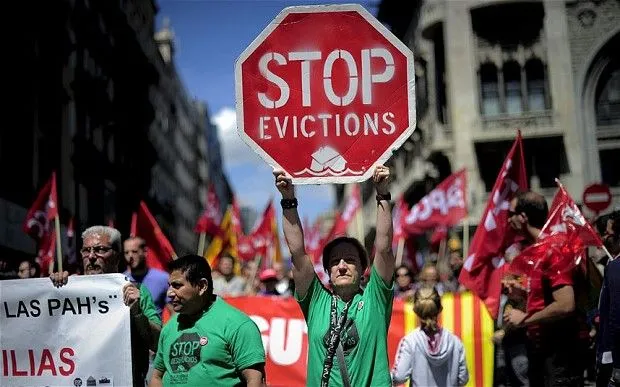
Planned Demonstrations and Continuing Mobilisation
The Tenants’ Union, which has played a central coordinating role, has called for demonstrations on Saturday in more than 50 cities. In a statement, the organisation described an “irreparable disconnect between what the people want and what the parties vote for.” In Madrid, protesters are expected to set off from several locations around midday and converge on Plaza de Cibeles in the centre of the city. The Puerta del Sol encampment is expected to remain a hub of activity.
Similar actions are planned in other urban centres. The movement has already shown an ability to mobilise quickly and sustain presence in public spaces. Organisers have also discussed the possibility of further escalation, including calls for a general strike focused on housing rights, although the immediate focus remains on the weekend marches and the continuation of the camps.
Political Implications
The rejection of the housing decrees has sharpened the political stakes. Recent opinion polls have generally placed the opposition Popular Party ahead of the Socialists. Opposition leaders have used the moment to press Sánchez on the viability of his government and to raise the prospect of an early election. Within the governing coalition and among its usual parliamentary allies, the loss of Junts’ support on this issue has underlined the difficulties of assembling majorities on contentious social legislation.
For the government, the episode illustrates the challenge of responding to street pressure while navigating a fragmented parliament. For protesters, the vote has reinforced the belief that institutional channels alone are insufficient and that sustained public mobilisation is necessary to force meaningful change.
What Comes Next
The coming days will test whether the protest movement can maintain momentum after the parliamentary setback and whether political parties can find any common ground on housing policy. The core demands voiced in the streets—greater security of tenure, limits on abrupt rent increases, and curbs on speculative practices—remain unresolved. Automatic renewal of contracts and stronger protections against the eviction of vulnerable tenants were central to the defeated package; their absence leaves many tenants in the same precarious position that triggered the original outcry.
Spain’s housing difficulties are not unique in Europe, but the speed with which a single eviction escalated into nationwide camps and repeated mass demonstrations reveals the depth of accumulated frustration. Saturday’s protests will serve as the latest public test of that frustration and of the political system’s capacity to address it. Whether the demonstrations produce new negotiations, further polarisation, or an accelerated electoral calendar remains to be seen. What is already clear is that the question of affordable and secure housing has moved firmly to the centre of Spain’s political agenda.
Read more – cricketscorerise.com