Stock Market Basics for New Investors: A Beginner’s Guide to Getting Started
Investing in the stock market can feel overwhelming at first, yet the core ideas are straightforward. Stocks give ordinary people a way to own pieces of companies and share in their growth over time. This guide walks through the essentials new investors need to understand before placing their first trade, from what stocks actually are to practical steps for getting started responsibly.
What Stocks Are and How the Market Works
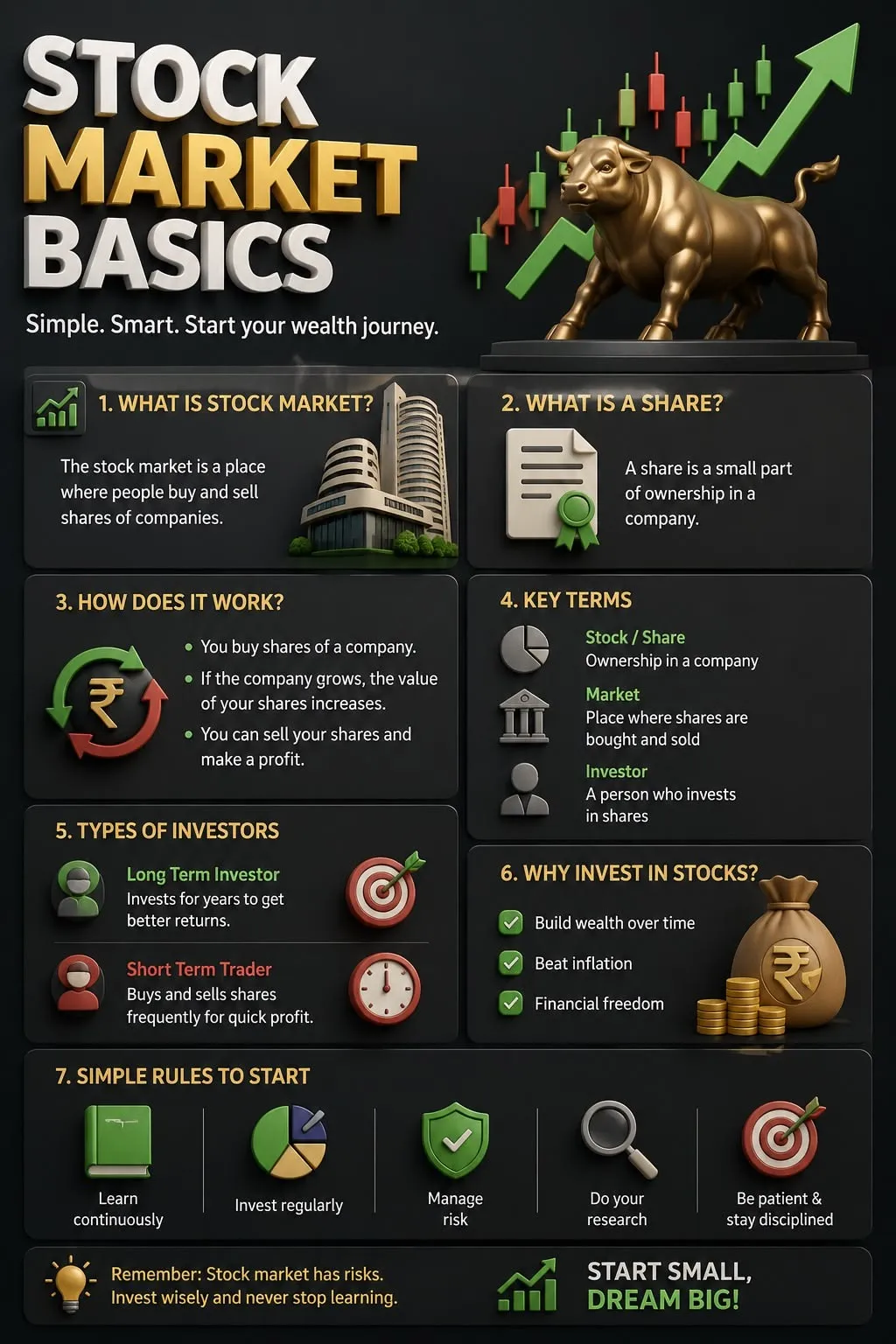
A stock represents a share of ownership in a publicly traded company. When you buy shares, you become a partial owner and gain a claim on a portion of the company’s future earnings and assets. Most shares trade on major exchanges such as the New York Stock Exchange and Nasdaq.
Companies issue stock to raise capital for growth, expansion, or other business needs. Once shares trade publicly, investors buy and sell them among themselves. Stock prices rise and fall based on company performance, earnings, economic conditions, and investor expectations.
Investors typically earn returns in two ways. Capital appreciation occurs when the share price increases and the investor sells at a higher price than the purchase price. Dividends occur when a company distributes a portion of its profits to shareholders. Not every company pays dividends, and prices can also decline, creating the possibility of loss.
The broader “stock market” is often discussed through indexes. An index tracks a group of stocks that represent either the overall market or a specific sector. When people say the market is up or down, they usually refer to movements in one of these major indexes.
Why Stocks Matter for Long-Term Wealth Building
Historically, U.S. stocks have delivered strong average annual returns over long periods—around 10 percent before inflation and roughly 7 to 8 percent after adjusting for inflation. This long-term growth potential comes with volatility. Prices fluctuate, sometimes sharply, and short-term losses are common.
Stocks generally suit money that will not be needed for several years. A common guideline is to invest only funds that can remain invested for at least five years. This time horizon allows investors to ride out temporary declines. Money needed for near-term expenses or emergencies belongs in safer places.
Key Concepts Every New Investor Should Know
Risk and Return
Stocks carry higher risk than cash or bonds because prices can fall. Higher potential returns come with the possibility of greater losses. Understanding personal risk tolerance—how much volatility one can accept without panic-selling—is essential.
Diversification
Owning shares in many companies across different industries reduces the impact of any single company performing poorly. One practical way to achieve diversification is through funds rather than individual stocks.
Time Horizon and Compounding
The longer money stays invested, the more opportunity it has to grow through compounding—returns generating their own returns. Starting earlier, even with small amounts, often produces stronger results than waiting for a larger sum.
Investing Versus Trading
Long-term investing focuses on buying and holding quality assets for years. Short-term trading involves frequent buying and selling in an attempt to profit from price swings. Most beginners fare better with a patient, long-term approach.
Practical Steps to Begin Investing
1. Clarify Goals and Timeline
Decide what the money is for—retirement, a future home, education, or general wealth building—and when it will be needed. Goals and time horizon shape the appropriate mix of investments and the level of risk that makes sense.
2. Choose the Right Account
A standard brokerage account offers flexibility with no contribution limits and easy access to funds, though gains may be taxable. Retirement accounts such as a 401(k) or IRA provide tax advantages but come with rules about contributions and withdrawals. Many people use both types. Robo-advisors offer automated portfolio management for those who prefer less hands-on involvement.
3. Open and Fund a Brokerage Account
Opening an account is similar to opening a bank account and can usually be completed online in minutes. Most major firms require no minimum balance. Once open, transfer money from a bank account. Many platforms now allow fractional shares, so even small dollar amounts can purchase pieces of expensive stocks or funds.
4. Decide Between Individual Stocks and Funds
Buying individual company shares requires research into business fundamentals, competitive position, and valuation. For most new investors, stock funds—especially low-cost index funds and exchange-traded funds (ETFs)—provide a simpler path. These funds hold baskets of stocks that track a market index, delivering instant diversification at low cost. An S&P 500 index fund, for example, gives exposure to hundreds of large U.S. companies in a single investment.
5. Invest Consistently and Review Periodically
Regular contributions, sometimes called dollar-cost averaging, help build the habit of investing and reduce the impact of buying at market peaks. Set a schedule, automate transfers if possible, and resist the urge to react to every market swing. Review the portfolio occasionally to ensure it still matches goals and risk tolerance, but avoid frequent changes driven by short-term news.
Important Guardrails for Beginners
Only invest money that is not required for living expenses or high-interest debt repayment. High-interest consumer debt often costs more than stocks can reasonably be expected to return, so paying it down first can be the higher-priority move.
Avoid concentrating too much money in a single stock or sector. Diversification across companies, industries, and sometimes geographies helps manage risk. Keep expectations realistic: markets experience corrections (declines of 10–20 percent) and occasional bear markets (declines greater than 20 percent). Historically, markets have recovered over time, but recovery is never guaranteed on a fixed schedule.
Focus on costs. Expense ratios on funds and any account fees reduce net returns. Low-cost index funds and commission-free trading at many brokers keep more money working for the investor.
Building Confidence Over Time
The stock market rewards patience and discipline more than constant activity. New investors do not need to master complex strategies or predict short-term movements. Understanding ownership, diversification, time horizon, and the power of consistent investing provides a solid foundation.
Start with clear goals, an appropriate account, diversified low-cost funds, and a commitment to stay invested through market cycles. Education continues after the first investment—reviewing statements, learning basic company analysis, and refining risk awareness all strengthen decision-making. With these fundamentals in place, new investors can participate in the long-term growth potential of the stock market with greater clarity and confidence.
Read more – GadgetsMonk.com